Research agenda · Work in exploration

Design reasoning as designs evolve

Design goals, constraints, and decisions evolve together. I explore how interactive tools can help people notice, reconsider, and reason through design decisions.

Design decision space

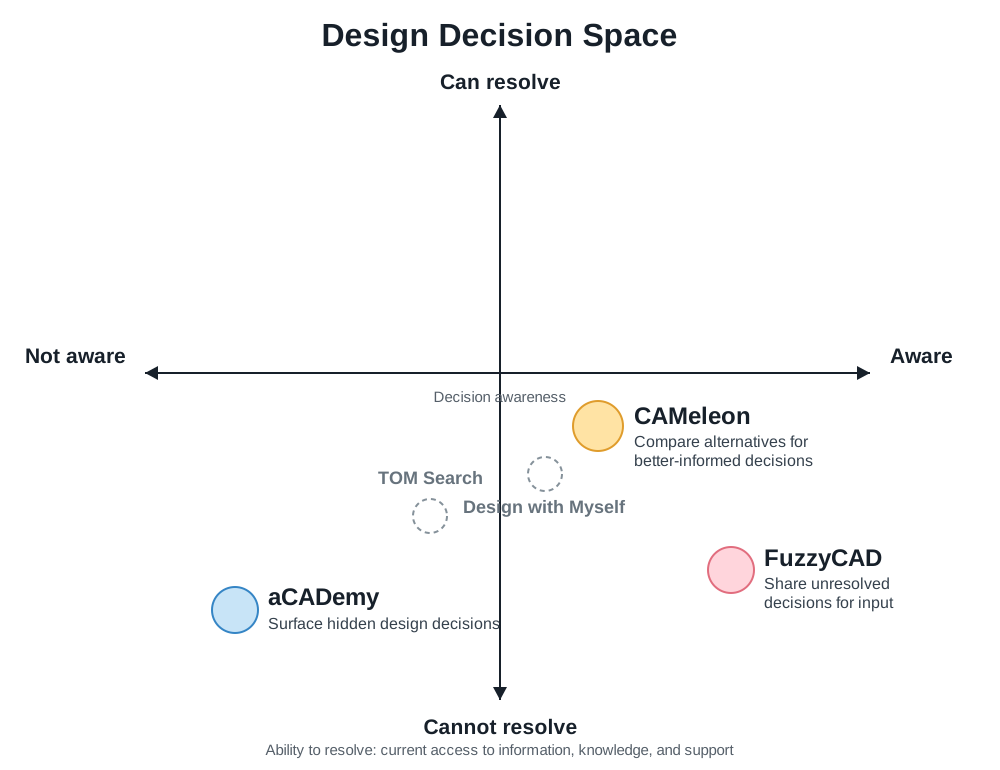
Two dimensions guide this agenda: awareness of a decision and the ability to resolve it. Both depend on the decision and can change during design. Collaboration and learning offer further questions within each state.

Conceptual design decision space. Horizontal axis: not aware to aware. Vertical axis: cannot resolve to can resolve. Solid markers indicate current research; dashed markers indicate related work.
Conceptual positions, not measured scores or fixed categories of designers.

Not aware · Can resolve

Discover a decision

A designer has relevant expertise but has not noticed that a decision needs attention.

Design questions

How do overlooked design issues emerge during designing?

How might different ways of seeing a design reveal relationships or requirements that were previously missed?

Collaboration · How can collaborators surface consequential relationships that others have overlooked?

Learning · How can discovering an overlooked decision change what a designer notices in future work?

Related theory and research

Situated invention · Suwa et al. (2000) — Unexpected features noticed in sketches can contribute to the formation of new design issues and requirements.

Kinds of seeing · Schön & Wiggins (1992) — Designers perceive and judge visual and spatial qualities while reasoning through changes to their designs.

Design fixation · Crilly (2015) — Professional designers can become constrained by existing solutions and reflect on strategies for overcoming that fixation.

More design research (3)

Visual re-cognition · Oxman (2002) — Visual and conceptual reinterpretation can make new forms and meanings emerge from a design.

Opportunistic design · Guindon (1990) — New requirements and partial solutions can prompt designers to move between levels of abstraction rather than follow a fixed sequence.

Visual representations as epistemic objects · Ewenstein & Whyte (2009) — In an architectural design study, incomplete visual representations supported ongoing inquiry and knowledge development.

Aware · Can resolve

Reason through a decision

A designer recognizes a decision and can address it, but still needs to evaluate choices and their implications.

Design questions

How can designers compare alternatives and reason about their trade-offs?

When should earlier design decisions reinforce, challenge, or inform current choices?

Collaboration · How can a team compare different rationales while preserving each designer’s decision-making agency?

Learning · How can reflection on decisions and outcomes inform designers’ future judgments?

Related theory and research

Design rationale / QOC · MacLean et al. (1991) — Questions, options, and criteria provide a structure for examining design alternatives and their reasoning.

Prior knowledge in design · Oxman (1990) — Designers can adapt, restructure, and reformulate precedents to use past knowledge in new situations.

Constructive memory · Liew & Gero (2004) — This computational design model reconstructs memories of past experience according to the current design situation.

More design research (4)

Design stories · Oxman (1994) — A model links issues, concepts, and forms so design precedents can be explored across contexts.

Primary generator · Darke (1979) — An initial guiding idea or constraint can organize the development and testing of a design.

Analogical reasoning and mental simulation · Ball & Christensen (2009) — Designers use analogies and imagined consequences as reasoning strategies associated with uncertainty.

Briefing and reframing · Paton & Dorst (2011) — Experienced designers reinterpret a client's framing and communicate alternative ways of understanding a problem.

Not aware · Cannot resolve

Recognize a knowledge need

A designer has not recognized a consequential decision and lacks some of the knowledge needed to resolve it.

Design questions

How can designers become aware of decisions beyond their current knowledge?

How can they recognize and articulate what they need to learn?

Collaboration · How can collaborators reveal one another’s knowledge gaps without assuming that any person has a complete answer?

Learning · How can designers identify and acquire relevant knowledge while working on a design?

Related theory and research

Design knowledge needs · Ahmed & Wallace (2004) — An empirical study found that novice engineering designers often did not explicitly recognize their own knowledge needs.

Design metacognition · Ball & Christensen (2019) — A review describes how uncertainty drives monitoring and regulation of design thinking.

More design research (2)

Design risks framework · Carlson et al. (2020) — Identifies metacognitive processes for focusing attention, recognizing risks, and choosing iteration strategies; novice teams lacked some risk-identification knowledge.

Embedded design critics · Fischer et al. (1993) — Contextual critiques in design environments can surface problems and prompt reflection during design.

Aware · Cannot resolve

Share an open decision

A designer recognizes what remains unresolved but needs information or expertise from elsewhere.

Design questions

How can designers communicate unresolved decisions so others can contribute?

How can different perspectives move a design forward without forcing premature agreement?

Collaboration · How can partial expertise be combined without requiring every collaborator to understand the entire design?

Learning · How can contributions from other disciplines help designers develop the knowledge needed for later decisions?

Related theory and research

Symmetry of ignorance · Fischer (2000) — Complex design knowledge is distributed across people, making differences in expertise a resource for collaborative creativity.
Boundary objects · Star & Griesemer (1989) — Shared objects can accommodate different viewpoints while retaining a recognizable identity across groups.

Boundary negotiating artifacts · Lee (2007) — Artifacts in collaboration can help establish, reshape, and contest the boundaries and practices of joint work.

More design research (4)

Knowledge boundaries · Carlile (2004) — Crossing syntactic, semantic, and pragmatic boundaries may require transferring, translating, or transforming knowledge.

Collaborative reframing · Stompff et al. (2016) — Surprises in multidisciplinary teams can prompt shared sensemaking and new problem frames.

Disciplinary difference and uncertainty · Dyer et al. (2021) — Design disciplines can understand and value uncertainty differently, with implications for interdisciplinary work.

Micro-conflicts and uncertainty · Paletz et al. (2017) — Brief disagreements were followed by different changes in uncertainty across the design teams studied.

Across the decision space

Problem–solution co-evolution · Dorst & Cross (2001) — Design problems and possible solutions develop together, changing which decisions matter.

Situated FBS · Gero & Kannengiesser (2004) — Designing is shaped by recursive relationships between changing environments, interpretations, and expectations.

Co-evolution and emergence · Dorst (2019) — Exploring solutions can lead designers to reinterpret the design problem itself.

Expansive learning for collaborative design · Tessier (2022) — Team challenges and actions can become material for collective reflection and learning during design.

Learning on demand · Fischer (1996) — Design environments can connect learning to the knowledge needed in an ongoing task.